The Art of the Pause
Apr 07, 2026We live in a culture that glorifies busyness. Keep doing. Keep producing. Keep proving.
And yet, many of the people I work with don’t need more effort - they need space.
I had to learn this myself. For a long time, pausing felt risky, even irresponsible. I worried that if I slowed down, I’d lose my edge or the next opportunity. What I didn’t realize was how much constant busyness was pulling me away from myself.
The pause is uncomfortable because it reveals what busyness keeps hidden: fatigue, longing, quiet truths we’ve been too rushed to hear. But it’s also where reconnection begins, not just with clarity, but with ourselves.
In mindfulness research, Jon Kabat-Zinn describes mindfulness as paying attention, on purpose, in the present moment, without judgment. Pausing creates the conditions for that kind of attention. It’s not about stopping life, it’s about noticing it.
Neuroscience reinforces this. Daniel Siegel’s work shows that when we pause and attend with awareness, the brain integrates emotion and reason more effectively. We become less reactive, more responsive. In that sense, the pause isn’t passive at all. It’s a reset.
Research on resilience adds another layer. Moments of reflection and positive emotion expand our capacity to cope, connect, and adapt. Without space, we can’t integrate experience; we can only accumulate it.
And still, pausing can feel threatening. Especially in high-achieving, service-oriented cultures, rest is often confused with laziness, and stillness with falling behind.
But what if the pause isn’t the opposite of progress, but part of it?
What if it’s the bridge between exhaustion and insight?
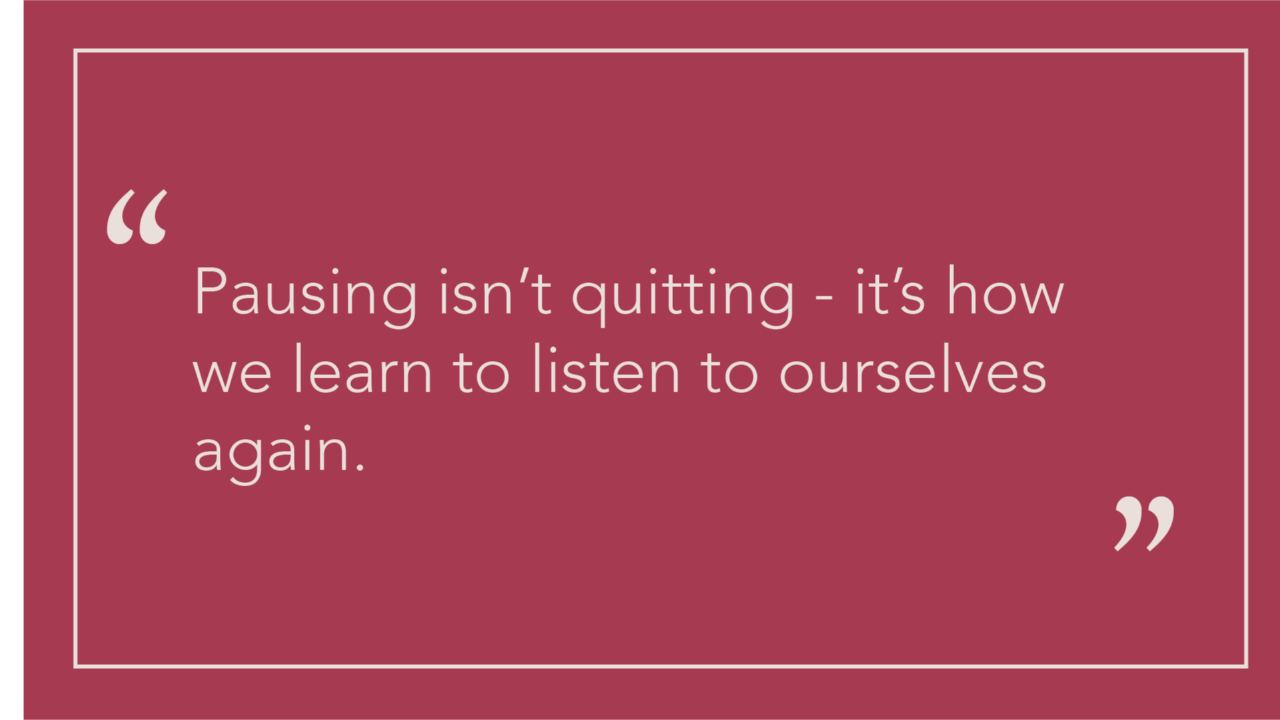
Pausing doesn’t mean giving up.
It means giving yourself back to yourself.
Even briefly.
Even imperfectly.
Reflection prompt
What might change if you allowed yourself a pause today - not to stop growing, but to grow differently?